

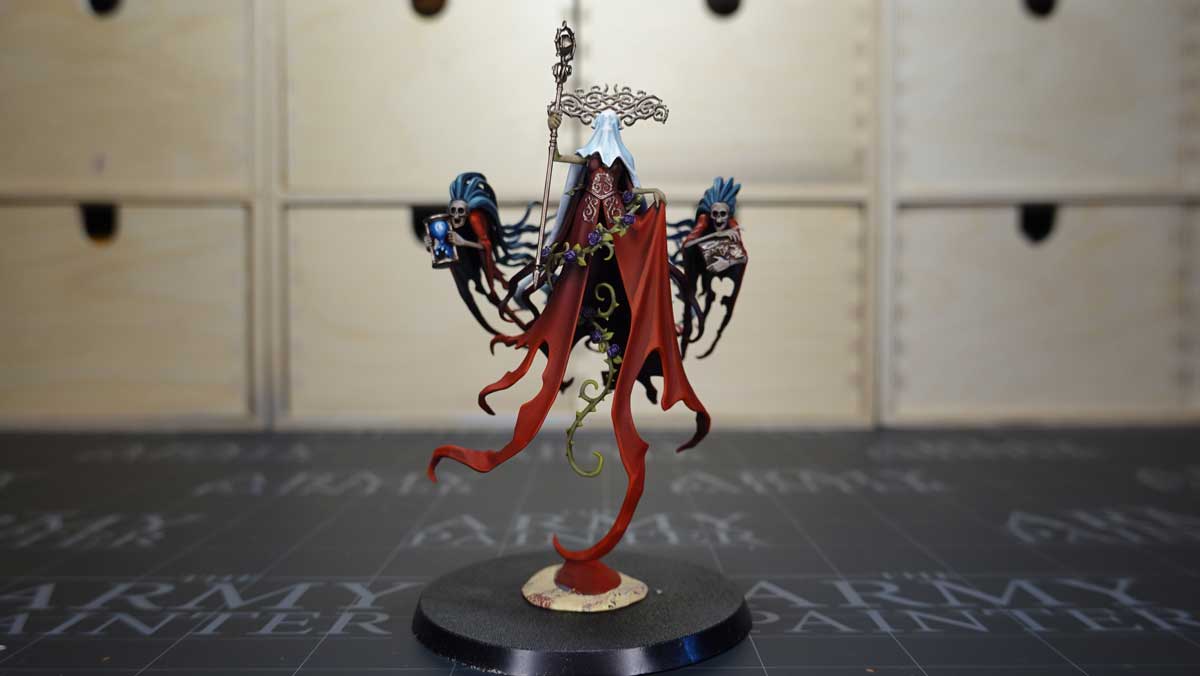
Painting Lady Olynder can be complex for beginners. I also had several difficulties, especially with the assembly. With this tutorial I hope to give you some tips on how to deal with this “beautiful and cursed” miniature. Let’s see together how to paint Lady Olynder.
Lady Olynder’s lore
Lady Olynder is the Mourning Bride, the Unrequited Queen, the Veiled Lady and the Mortarch of Grief. She is the manifestation of despair, suffering that takes shape. In her are all the pain and sorrows of the Realms. Her power transcends mere sadness, exudes devastating waves of fear and desolation.
Lady Olynder’s miniature literally floats on the ground, she wears a ghostly wedding dress and veil, so much so that little can be seen of her actual shape other than the outline of a skull. The bridal train is ruined and torn, it flutters behind her connecting it to the base. Brambles of roses sprout where she walks, wrapping around up to her headdress.
In her right hand he holds the Midnight Staff, an ornate stirrup on which sits a shiny gem of vitrified funeral sand. She is accompanied by 2 macabre Banshee Handmaidens, horrifying skull-faced ghosts.
Lady Olynder was certainly the most difficult miniature she has ever assembled and painted, as beautiful as it is cursed due to its subtle and difficult to manage parts. All in all, however, the final result satisfied me with all the curses that I put down during the works …
How to paint Lady Olynder
Lady Olynder’s box takes up the classic dimensions of GW’s special characters. Inside you will find two frames and assembly instructions, always very detailed and easy to follow. As always, following the instructions, remove the parts and clean them of print residues, being careful with the cutter. The smaller parts, the thin brambles, make assembly a bit complex, especially for those with big hands like mine …
To paint Lady Olynder, I decided to use two different primers for the two parts of the miniature: black for the body and white for the face cloth, due to the two different colors I decided to use. This involved a modification, that is, to fix the face to the cloth separately from the torso and to remove a small “tooth” at the nape of the neck which improved fixing. In this way, I can later glue the head by lowering it onto the neck from above. The Banshees on the second sprue are quite simple to assemble, being made in a few pieces.
Primer and base colors with airbrush
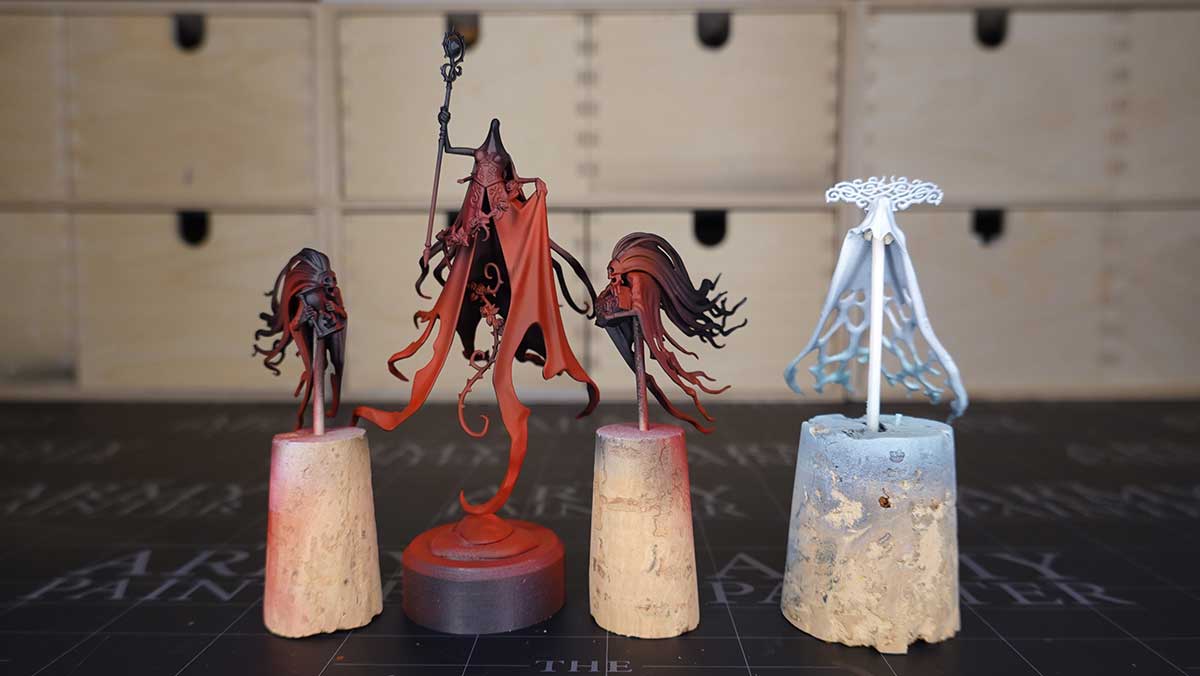
As I told you, I gave two different primers starting with the black one for Lady Olynder’s body and the two Banshees. From these images you can see how before giving the primer I preferred to correct some slightly closed cracks with green matter. Even if I am not going to paint it, it is always good to apply the primer even on the internal parts where you do not intend to paint with a brush, just to make sure that at no point you notice the gray plastic of the sprue.
Black primer also for the Banshee, which are fixed to the cork support with a simple toothpick and a ball of Patafix. With some diluted Khorne Red, I started coloring Lady Olynder’s robes red, starting from the bottom. Going up, I tilted the airbrush jet so that it did not come to cover the highest parts of the miniature.
Same identical speech for the Banshees, wanting them to dress in the same way. In this case, I concentrated the color on their shoulders because they are more exposed to light. With Mephiston Red, I gave more brightness to the shreds in the wind and the part of the sheet pulled up by her hand. At this stage, be careful not to completely cover the previous work, but try to obtain a gradient by reducing the area in which to add color.
Again, same work on the two Banshees, accentuating the tips of the shreds and the shoulders. The time has come for the face and the towel that I primed with white. Here too, try to reach the innermost areas so that no part remains uncovered. I then switched to Toxic Mist from The Army Painter, a desaturated blue that I gave to the outer shreds of the cloth to give it a more spooky look.
Edge highlight and details
Let’s continue with the cloth giving a few more shots of light and a bit of Edge Highlight with Citadel’s Evil Sunz Scarlet. As always, try to identify the folds in the sheet that are most exposed to light. At the same time, give a line of brighter color to the edges to make the cloth outlined and recognizable.
At this stage, you need the right dilution. The color must not be too thin to slip, nor too dense to be excessively different from the basic red. To paint the edges of thin parts such as the cloth, use the back of the brush instead of the tip, this will guarantee continuity in the application.
My goal here was to attract the attention of those looking at the miniature on Lady Olynder’s hand. To do this, I tried to lighten the cloth under her hand, as if pulling the light hit her folds more brightly.
Using a diluted color in these cases is essential, because it allows you to create gradients progressively. This is why I often go back over the same areas: reducing the area of interest accentuates the intensity of the color, creating brighter areas and darker areas.
Painting Lady Olynder’s Banshees
The same goes for the two Banshees, where always with Evil Sunz Scarlet I gave light to the outer edges of the tunics, shoulders and elbows, which are also more exposed to light. Rakarth Flesh is often my first choice when it comes to bones, so I used it as a base for the skulls and arms of the two Banshees, but also for Lady Olynder herself. As you will see, what will differentiate the 3 characters will be the shader. When painting the base color on skulls, it is good to avoid painting inside the orbital cavities and in the nose, this is to let the black of the primer keep these parts dark, leaving the face to remain visible.
Stegadon Scale Green is another Citadel base color. Despite the name, I consider it a cold and dull blue, ideal as a base for the hair of our two nice Banshees. Raggaroth Night, on the other hand, is a purple that I desaturated and blended with the previous color to make the transition to the ends of the hair softer. I therefore used this color roughly and without overloading the brush. In favor of the next step. Matt Black from The Army Painter is a simple matte black. I then dirtied the Drybrush Masterclass to brush the tips of the hair, thus creating a gradient that goes from blue to black, passing through a hint of purple that gives the character ghostly.
However, it is necessary to accentuate the shadows of the various hair strands, to do this I gave a coat of shade, Drakenhof Nightshade by Citadel, a dark and desaturated blue too. Once dry, I took up the Rakarth Flesh and mixed it in equal parts with Stegadon Scale Green to lighten the blue without desaturating it. Well diluted, it proved to be an excellent shade to be applied to the hairline.
With the color still wet, I lightened the color even more, increasing the component of Rakarth Flesh, reducing the area of application to the “skin”. Concluded the work on the hair, I also gave a coat of shade to the face and arms with the classic Agrax Earthshade.
The Midnight Staff
Cursed Blade is a “coppery” silver that I received from The Army Painter with the D&D set. This color struck me so much that I found it ideal for Lady Olynder’s metal parts, without even the need for a shade. If you still want to help out, a sepia color looks great.
The Midnight gem also had to be painted here, but I didn’t feel like it … (shame! Shame! Shame!) Then it was finally time for me to use the Death Guard Green for the first time, which as you will remember, I never used to my Death Guard miniatures. Instead, I found it perfect in this case, because it is desaturated and dull compared to a normal green, therefore ideal for brambles. I could have done the brambles brown, but the green is complementary to the red thus creating a great contrast. And for the same reason, namely the already high presence of red, I painted the roses with Naggaroth Night. To give depth to the leaves, I gave a coat of shade with Athonian Camoshade which is perfect when applied on Death Guard Green.
Same shade for the complexion of our Lady, in order to recall the typical colors of a rotting body, even if it should be a ghost, I know … To give brightness to the leaves and the ends of the bramble, I added to the base color of the Yriel Yellow. As I have often said and if you follow me in fact, you will know that lightening a color with yellow makes the color more saturated than white.
With a very thin brush then, I went to give strokes with the color thus obtained to all the ends of the bramble, in particular to the leaves. With Orc Blood from The Army Painter, I also gave the roses some highlights.
The veil of Lady Olynder
We just have to focus on Lady Olynder’s veil and face. Nighthaunt Gloom is a very light shade made especially for this faction of Age Of Sigmar. I bought it for the ghosts of Zombicide No rest For the Wicked, but then I sold that set without ever painting them … so this color was still brand new too!
I diluted it a little to try to enhance only the lower folds of the face and the upper part of the veil. With Matt White from The Army Painter, I applied some edge highlight to the face and to all the edges of the shreds of the veil, this gave contrast as the Toxic Myst is particularly blue and contrasts with pure white.
After painting, it’s time to glue all the parts together. So I finished the job by adding some details, especially to the two Banshees.
Conclusions about painting Lady Olynder
Painting Lady Olynder as already said was not easy, I had to give up part of the brambles due to the excessive complexity (difficult to reach all parts by cleaning all the brambles immediately) and the thin and “floating” parts. It really feels like painting a ghost considering that each flap does nothing but move under the brushstrokes! Despite the difficulties, however, in the end the result satisfies. Definitely a different miniature than usual and beautifully designed by the artists of Games Workshop.