'/%3E%3C/svg%3E)

So you start painting miniatures and after a while you hear about airbrushing. But how to start painting miniatures with airbrush? Let’s see together which choices to take to take this step and how not to spend a fortune since you first have to learn to master the new tool. This article is therefore dedicated to those who have been painting miniatures for a while and would like to take the “big step” by purchasing an airbrush.
Why using the airbrush to paint miniatures?
The airbrush is nothing more than a tool, as are brushes. Your creativity will use it to get fantastic results. But a first advantage in using the airbrush also as a beginner, is that you can spread the primers much better than a spray can or a brush can do, this will increase the quality of your paintings. You will now have a color base uniform and much thinner, which will allow you to enhance the details more. So one way to get practiced with the airbrush is to use it to apply primers to your miniatures. Moreover, the pre-shading technique will open the way to a new way of painting.
What pre-shading is and how it works
After spreading a first uniform layer of black primer with the airbrush, gradually apply “sprinkles” of white primer from the top of the miniature. In this way the shadows will be enhanced and you will have more way to understand the shapes of the miniature during painting. Below is an example.
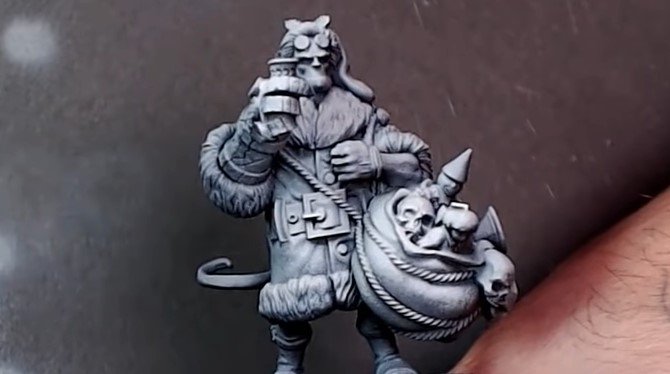
Image from spikeybits.com
The advantages of painting miniatures with airbrush
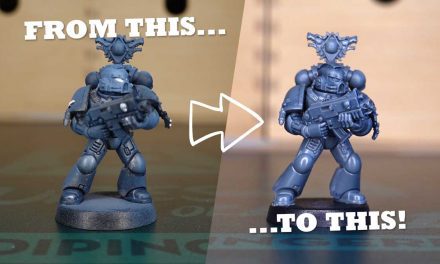
What you can do with the airbrush during painting are gradients that would otherwise be difficult to achieve by brush. The airbrush is in fact ideal for painting large surfaces, blending colors and creating remarkable gradient effects. One of the last uses I did was to create the color base for the armor of some Space Marines.
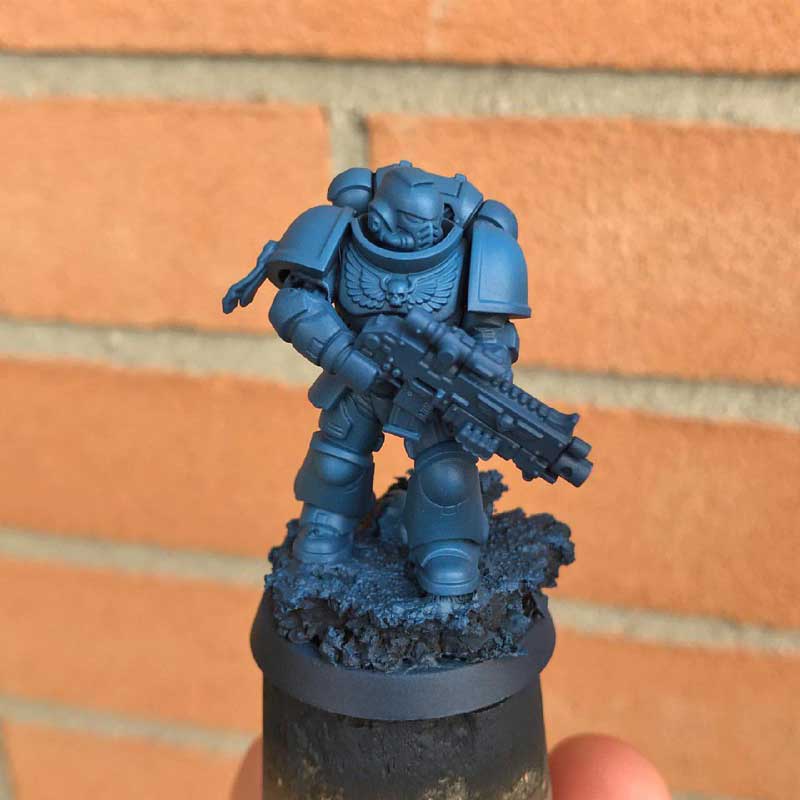
Don’t you think a base like this is better than starting with a flat blue? With the airbrush you will have the opportunity to give depth to the base color of your miniatures, you’re going to create shades, then you can add details over it. But this is just an example, on YouTube you can surely find lots of videos of artists who paint their miniatures using the airbrush in many ways.
But which airbrush should i buy to paint miniatures?
For those who are in the first experience and do not know which airbrush to buy, they may find themselves caught off guard by the enormity of price ranges and models. Let’s start by saying that the most used model for miniatures is the gravity model, which allows a continuous and homogeneous flow of color. Therefore exclude those with pistol or can.

Choose the right airbrush to paint miniatures
There are various philosophies of thought on how to approach the purchase of an airbrush. For example, Angel Giraldez, one of the best in the world in miniatures painting, in a recent video on YouTube stated that it is not worthwhile to buy an “economic” model to start airbrushing, because the difficulties could be aggravated by the poor quality of the product making you pass the urge.
This may be true if you have the opportunity to meet in person with someone who has been using the airbrush for a long time. Someone who may even let you see how to use it and maintain it. If you don’t have this possibility, I don’t think Angel is right. A basic branded airbrush starts at a minimum of 170$ and spare parts can also cost 30$ or 40$. Not that cheap…
Using such an instrument at the beginning, without any experience, without someone showing us how to do it, can be dangerous because it can easily be damaged, with the risk of having to buy back even expensive components. Better then take it slow and buy a low-cost airbrush first, such as those you can find on Amazon. With a cost of 30$ or maybe less, you can find replicas that can help us become familiar with cleaning, assembly and disassembly and, of course, with painting. All while obtaining however discrete results. I advise you to start by giving priority to maintenance and getting to know the new instrument rather than the results. In this sense, an airbrush like this is fine.

If you decide to start from this, however, you must be aware that it is an airbrush intended only for the purpose of getting you to practice without damage. An airbrush of this kind in fact works well only for a few months, say a year, then it will start to give you problems because the poor quality of the metals, small components can break, as happened to me, or be easily deformed compromising the quality of the spray.
Try to use it only as long as necessary to understand if you are ready for the leap in quality, at which point you can switch to a more professional product. After informing myself about different brands and models, my choice fell on an Iwata Eclipse HP-CS.

It is a mid-range model with an approximate cost of 170$. Holding it the first time makes you immediately understand the level of quality: the movements of the mechanical parts are precise and the materials are a totally different thing. I have been using it for over a year now and I can assure you that it worth every single dollar it costs. It is the right choice for those who want a precise tool, able to help them achieve better works and venture into new painting techniques.
The Airbrush Compressor: which to buy?
Opposite opinion if we talk about compressors. In my opinion, you cannot choose a low-end compressor and then switch to a better one. You risk having a negative experience that can compromise your drive to continue using the airbrush. You should better look for a model that has all the features you need to paint miniatures, which are:
- Constant pressure
- Pressure calibration
- Poor noise
To achieve this, exclude all those compressors that do not have a cylinder. The latter in fact will allow you to have a constant flow of air and not to have to constantly suffer engine noise.
The most used model, even from very good artists, I have seen to be this. I have been using it for a couple of years, a great product I have to say, it does its duty without making too much noise and providing an adjustable and, above all, continuous flow of air.
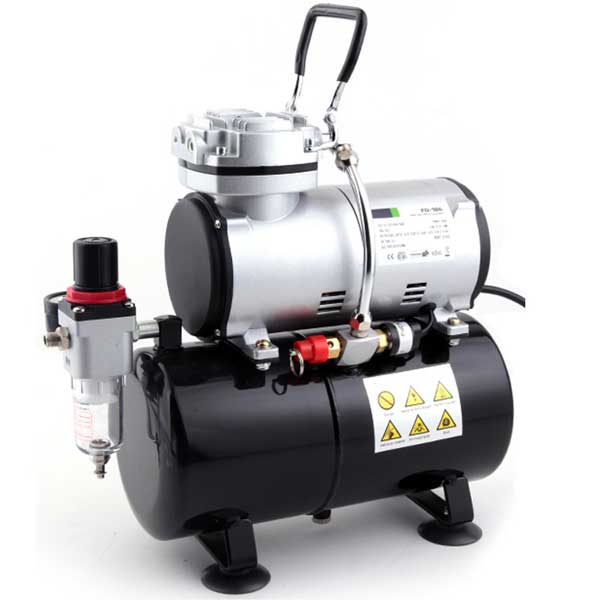
At Amazon it is about eighty dollars, unfortunately I do not recommend spending less than this if you want to progress in this hobby.
My advice is therefore to save on the airbrush initially, but to invest immediately on the right compressor, in order to not compromise your painting experience with the new instrument.
How to start painting miniatures with airbrush
Ok, all clear, but how do you use the airbrush to paint miniatures?
The web is full of guides on how to start painting miniatures with airbrush, but as always in this hobby the difference is made by experience. So, choose which purchases to make, initially do paper tests to understand how the airbrush works, distances, pressure, coverage area. Here are some videos that can help you better understand how an airbrush works, how to maintain it and how to use it to paint, waiting a video from my YouTube channel: