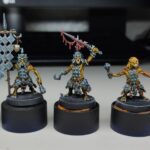


Painting miniatures is an art that, as we know, requires patience, practice and attention to detail. However, even the most experienced painters can make common mistakes that compromise the final result, especially if you take many things for granted or are in a hurry, which unfortunately is not uncommon. In this article, we will explore the 10 most common mistakes made by miniature painters, especially in the world of Warhammer, and I will give you practical advice to avoid them. Also because after so many years, I admit to having made practically all of them (or almost).
Not cleaning miniatures before painting them
One of the most common mistakes is skipping the preparation phase. Miniatures, especially those made of resin or plastic, can have printing residues or grease that prevent the paint from adhering correctly.
How to avoid it
Wash the miniatures with water and neutral soap, even simple Marseille soap. Use a brush to remove the residues and let them dry completely before starting to paint. It is very important that there are no water droplets in the gaps, they could prevent the primer from adhering.
Using too much paint (or diluting it poorly and poorly)
This is a mistake that especially beginners make. Applying too thick a layer of paint is a classic mistake that hides the details of the miniature and creates a “lumpy” effect. The color must be applied in layers, never using pure color, but diluting it with water. For this reason, the use of a wet palette is strongly recommended.
How to avoid it
Dilute the paints with a little water or painting medium and apply several thin layers, letting them dry well between each one.
Ignoring the preparation of the bases
The bases of miniatures are often overlooked, but they are essential to give a complete and professional look to your work.
How to avoid it
Spend time creating the bases, using materials such as sand, rocks or static grass and simple Vinavil glue. An economical way to make them more emphasized and give depth to your work.
Also, never forget to apply a coat of paint to the edge of the base, which will almost certainly be full of smudged paint and incorrect dry-brush strokes. Clean everything by covering with black or, as Games Workshop likes, with brown.
Don’t use a primer
It seems absurd, but many people do it at the beginning. Skipping the primer phase is a mistake that can compromise the adhesion of the paint and the durability of your miniature. In fact, the primer is a bonding agent: without this layer the color does not adhere and you will end up applying much, much more than necessary with obvious loss of detail and a mess that is half enough. Not to mention that, as mentioned, the color will surely end up peeling off.
How to avoid it
Always apply a primer (spray, brush or airbrush) before starting to paint. Choose a color that suits your scheme (for example, black for deep shadows, white for colors like Contrast or SpeedPaint).
Neglecting shadows and highlights
Painting a miniature without shadows and highlights makes it look flat and unrealistic. I know that these are steps that require time and dedication, but the result will certainly benefit.
How to avoid it
If you are new to miniatures, learn right away how to use washes to accentuate the shadows and how to highlight the most highlighted parts. Experiment with strong contrasts to bring out the details.
Choosing a color palette that is too complex
Using too many colors or the wrong combinations can make the miniature chaotic and inharmonious. Often, you do not need to use a lot of colors, but only a gradation of the same two colors. A Warhammer marine in two colors, adequately highlighted and with the right shadows, can be much more expressive than a marine painted with 5 or 6 different colors.
How to avoid it
Limit your palette to 2 or 3 main colors, then use gradients and complementary shades to give depth. Plan the color scheme before starting, always.
Not cleaning brushes properly
Dirty or badly treated brushes lose their shape and make it difficult to apply paint accurately. Given their cost, it is always a good idea to give them the utmost attention and care.
How to avoid it
Always clean brushes with cool water, at most slightly warm (but not essential) after each use or color change. Never let the paint dry on the brush. Also, always remember that the brush is used in one direction only, both when painting and cleaning, as well as when drying on kitchen paper or cloth.
Rushing to finish
This is more of a veteran’s mistake than a beginner’s mistake. Painting miniatures requires time and patience. Rushing to finish leads to mistakes and disappointing results. This is a sure rule, like gravity or the speed of light. There is no escape.
How to avoid it (and I say this more to myself than to you who are reading)
Take your time, work in short but focused sessions and enjoy the process. Remember: one well-made miniature is better than ten poorly-made ones!
Don’t use a miniature stand
Holding miniatures in your hand while painting can cause smudges and smudges, but it will definitely fall out while you paint. And because of Murphy’s Law, it will fall into the paint in your wet palette. Have I scared you enough? Well, it is absolutely not recommended to paint a miniature while holding it by its base. And there is no need to buy an expensive professional stand. I always suggest the best one to my friends at Baretto delle Miniature: a Neutro Roberts stick deodorant turned inside out with a ball of Pattafix! I assure you that it is an excellent holder at zero cost. Don’t thank me!
How to avoid it
Use a miniature support (such as a large cork or a professional support) to maintain a stable and comfortable grip.
Don’t experiment with new techniques
Always sticking to the same techniques limits your growth as a painter.
How to avoid it
Try new techniques such as wet blending, drybrushing if you are just starting out, or the use of metallic paints and special effects. Always remember that there is no right way to do things, only your creativity and desire to learn. And I know what you are thinking now: “but miniatures are expensive and I don’t want to ruin it!”
The fear of ruining the miniature is there, but you must always think that this is a journey and that your miniature will always be the one you still have to paint. Furthermore, if you have put the previous points into practice you will have already planned the work, knowing what you want to achieve.
Conclusion
Given that it is by making mistakes that you will learn to paint, reading and knowing these common mistakes in advance will help you reduce your learning curve, greatly improve the quality of your miniatures and enjoy the painting process even more. Remember: every mistake is an opportunity to learn and grow. If you have any other tips or questions, leave a comment below and share your experience with the Miniatures of Death community!