'/%3E%3C/svg%3E)


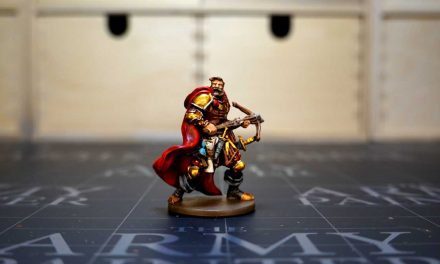
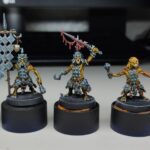
Painting Berin from Zombicide was a little different than the other characters. I went more to sensation, without following a set pattern. I simply enjoyed a little relaxation by coloring this miniature as I liked. This was also possible thanks to the use of the wet palette, which allows you to always have colors available, even those that you may have used hours before.
Paint Berin from Zombicide
Let us pause for a moment on the preparation of the miniature, which should never be underestimated. Make sure you have removed all excess production because I assure you that once painted they will be seen a lot and you will hate yourself for not listening to me! Before you start painting the miniature then thoroughly clean any residue and production line.
For all the Zombicide miniatures in this video series, I am trying to replicate the colors of the illustrations starting from a black primer, but nothing prevents the use of another color, it is purely a personal choice. In this case I prefer it this way because it gives the miniatures a darker shade, you will have noticed that when I paint I always try to let the primer show in the creeks and in the darkest areas. As I told you before, this time I did not follow a precise pattern, I started painting like this starting from the beard. I put some colors on the wet palette from brown to yellow, passing through orange, in order to have all the shades immediately available. So I started with a brown base that I gradually lightened with a few thin coats of increasingly lighter color, until I reached yellow.
Going fast enough with these gradual color transitions, thanks also to the use of the wet palette, you can create shades by painting directly on the fresh color, what in jargon is called “wet blending”, literally: mixing in wet. After shaving I took care of the leather surplice, I used the same colors already present on the wet palette and used for the beard, with the exception of orange. With brown I gave the base color, highlighting the brightest parts by mixing the color with the ocher yellow. I avoided giving the color to the whole armor, leaving the black of the primer between the inlets to mark the shadows more, but I think you have understood this by now.
For the purple parts of the miniature, I used a mix of two purple colors: one brighter and brighter and one less, mixing them I desaturated the first a little. In giving this color, I noticed some parts of the beard that I had not finished. As I said before I’m going off the cuff, so I took the oranges back to complete this part. It’s not always vital to follow steps, it can still be fun to paint just for the fun of it, as it comes to you and simply prioritizing what inspires you the most. It always depends on your goal: do you usually prefer to have fun and relax or finish painting your miniatures as soon as possible? Let me know in a comment.
The time has come to paint the complexion of the arms and face. Again, I preferred to give the color by mixing it directly between the palette and on the miniature itself. Are you noticing that in this video I’m not really telling you all the colors I use? It was my intention in fact to show you that there are no written rules in this hobby. I thought that my videos often follow precise steps, but it’s not a rule and the wet palette helps you in this because it keeps the color moist for a long time, allowing you to reuse it even after some time. So experiment and try to paint just to have fun, you will see that this hobby will reward you with moments of true relaxation.
Berin’s ax is particular. In fact, the blade is not made of metal but of a green stone with yellow veins. Before creating this effect I colored the gold part, then I gave the blade a green base, adding a touch of blue to make it colder and contrast more with the yellow of the veins. Again I went on to paint gradually, lightening the green by adding more and more yellow.
The metallic effect colors such as gold, silver, iron, contain pigments that reflect the light to create that shimmer that makes them metallic. For this reason, when you use them always try to change the water with which you rinse the brush and if possible also the paper of the wet palette or your palette. This way you will avoid that they go to contaminate the other colors. I used a silver for the shoulder straps, the studs on the leather mail and for the hammer. In reality, Berin does not have a real coat, but a wolf skin. I’ve always found it fun to paint them because with the drybrush it’s something really fun … it reminded me a little of my first miniature …
In this case I started from the inside, giving the g