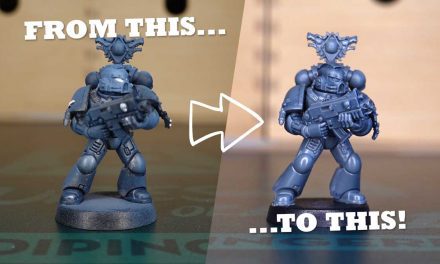


The slapchop technique. Surely I’ve heard of it lately. I do a lot and this makes me want to try it in recent days. But what is the slapchop technique? It is a technique for the quick painting of miniatures which provides a gray base given by drybrush to a miniature with a black primer, to which the details are then enhanced with a second coat of white drybrush. On this basis thus obtained, transparent, diluted colors are then applied. Clearly, it’s ideal for using colors like Citadel’s Contrasts or The Army Painter’s Speedpaints. But let’s see in more detail what I have created in order to describe step by step what slapchop is.
Slapchop technique: let’s make a premise
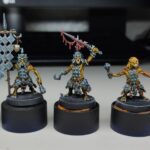
This is not a definitive guide, but the story of how I made these 5 miniatures in about 2 hours. Read to the end because at the bottom you will find some considerations that I have made, evaluating errors and tricks that I will try to correct next time. To make these miniatures I used colors from The Army Painter. But the sequence and technique can also be used with colors of the same type but from another manufacturer.
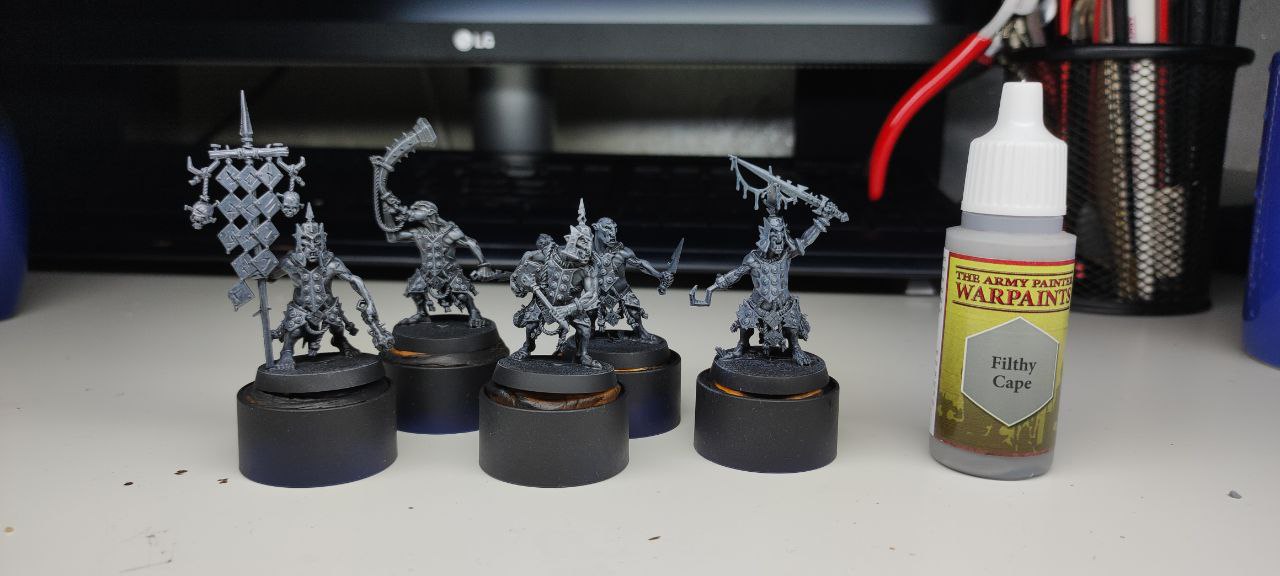
Step 1: the basic gray drybrush
So let’s start as mentioned from a miniature with a black primer base already applied. I applied Filthy Cape, a gray base, using the drybrush. I spread the color almost evenly but be careful to unload the brush very well to avoid a mess. The drybrush requires a little patience, if you give the brushes with the color still fresh on the bristles you risk making a big mess.
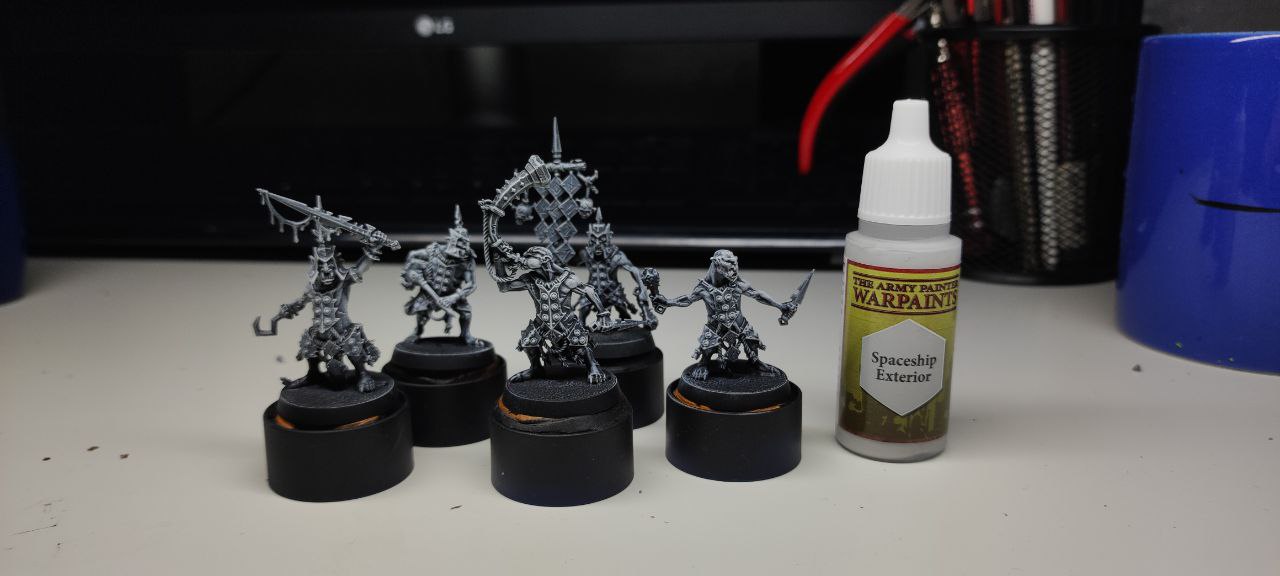
Step 2: the clear drybrush for the highlight
At this point I applied Spaceship Exterior with the same brush, a very light and cold gray. Here the drybrush is applied from top to bottom, trying to avoid transversal brushing. The goal is to highlight edges, corners and simulate lighting from above. As you will have understood if you read me often, it is a zenithal highlight given with the drybrush instead of the airbrush.
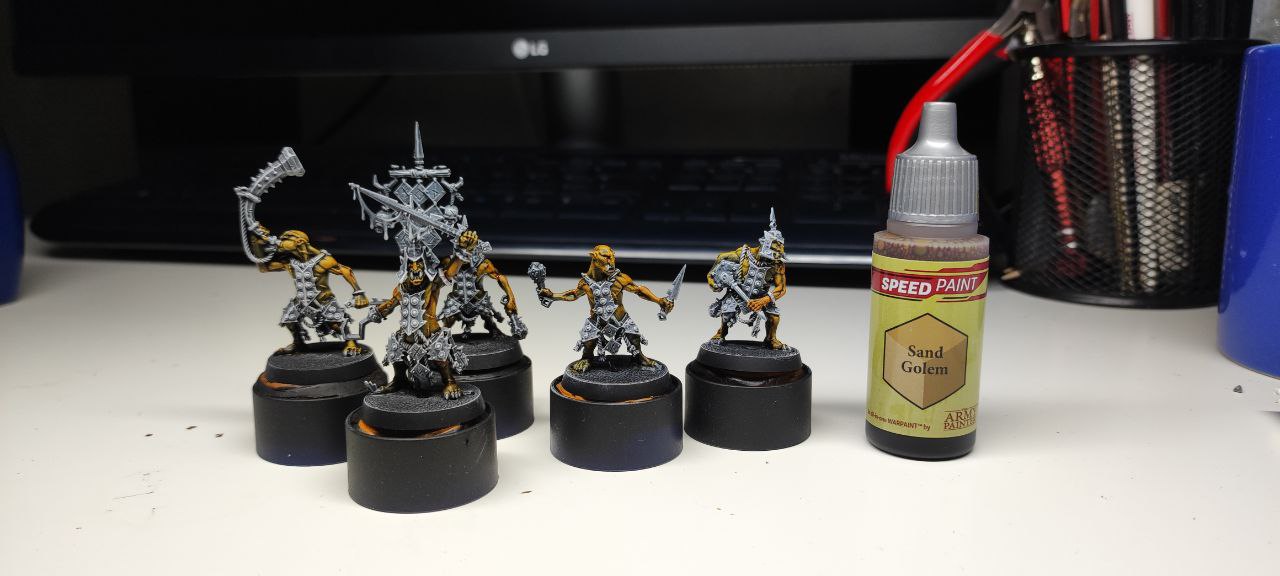
Step 3: color the leather with Speedpaint
Speedpaints are The Army Painter’s proposal for “one thick coat” coloring, that is, transparent colors that generate shadows and lights with a single pass if applied on a white color primer. As you know if you’ve been following me for a while, using these colors in this way is an aberration for me, I don’t mince words. I find the result dirty, low quality, approximate, annoying to the eyes. Even when I tried them for the first time I decided to apply a zenithal highlight to the miniature rather than paint from a flat white primer.
However, it is different if slapchop is applied. With this technique the Speedpaints are exciting, with just one pass you can create a perfect incarnate effect for the gaming table! And I also had fun using them. I started by applying Sand Golem to the embodied parts of these “Hobgrot Slittaz”, very delicate name.
With Hardened Leather I continued the coloring by painting the bridles and the leather parts.
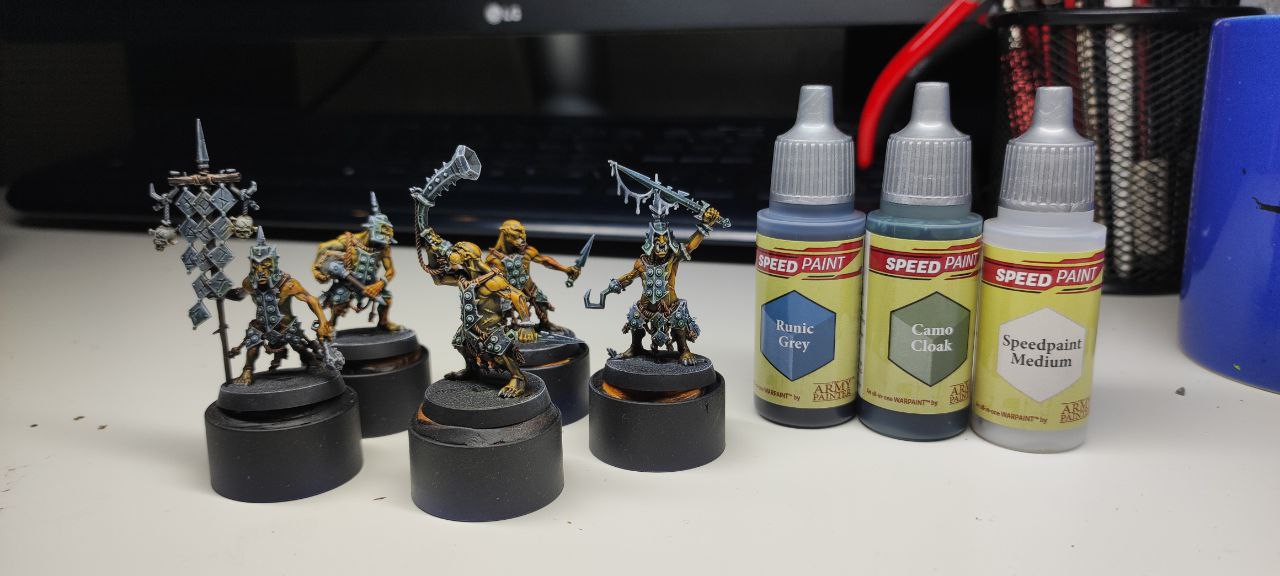
Step 4: metal effect without metallics
The Army Painter has just launched the new Speedpaint series called “2.0” with which it is preparing to widen the range from the current 24 to 50 colors, practically doubling it. Furthermore, the Speedpaint 2.0 will use a new revised formula, after some controversy over a possible reactivation of the color when going to highlight (I personally have never experimented with it, but I didn’t work with them a lot). Among the new colors, there are also 3 metallics, The Army Painter is the first to produce them. We’ll see how they will be, meanwhile I invented a solution for the metal parts of our “Hobgrot Slittaz”.
By diluting Runic Gray and Camo Cloak with the supplied Medium, I applied a semi-transparent color on the metal parts. So I didn’t mix them together, but I applied them on different parts to create diversity and also simulate oxidation from humidity. I really liked the result and I really don’t think it needs another metallic color. That’s already a great result for me.
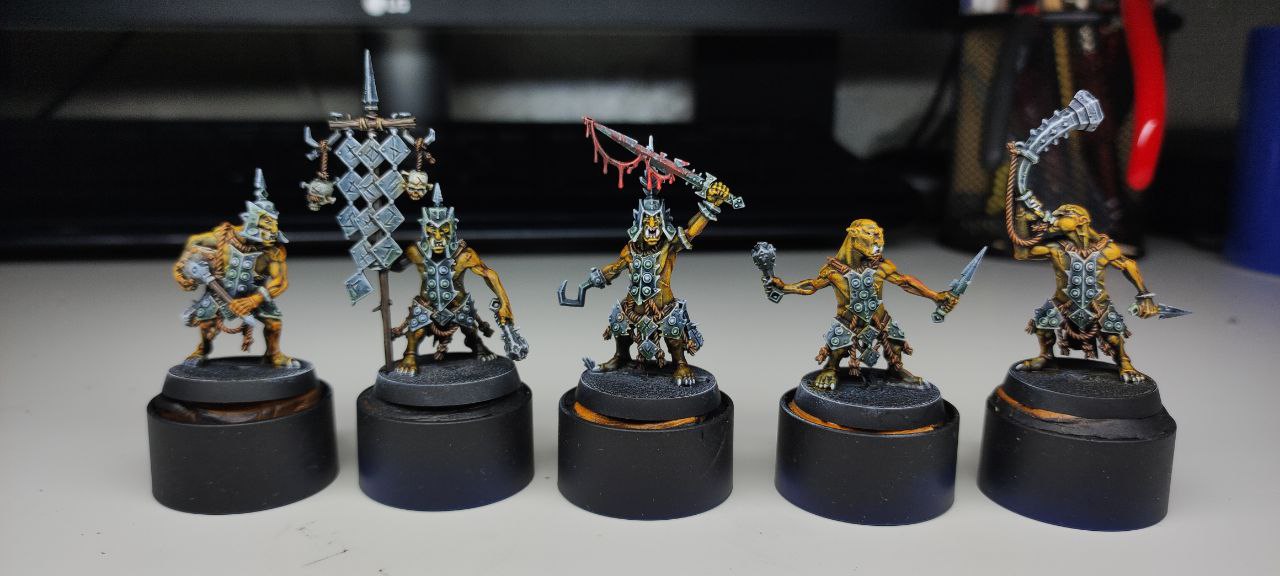
Step 5: details
To conclude the work, I dedicated myself individually to each miniature, going to paint the eyes and teeth by “recycling” the Spaceship Exterior already used for the drybrush. Using the Blood Red you get an excellent blood effect if applied on the miniature already treated with the drybrush, as seen. The only thing would be better to apply a gloss varnish as the Speedpaints are particularly opaque and the blood comes out well if polished.
Slapchop technique: my conclusions
As mentioned, these 5 miniatures were meant to be an attempt to test myself with the slapchop technique, which I personally approve with full marks. In a very short time I finished painting 5 miniatures at game level and I’m really happy with the result. However, I have not been free from mistakes that I hope to avoid with the next attempt. First of all rejected the light gray for the second coat of drybrush. Speedpaints tend to darken the areas where they are applied, so not having a purely bright color base underneath, such as a white can be, is not an advantage at all.
Another thing to keep in mind is that by their very nature Speedpaints are not opaque. So if you’re wrong you can’t correct it with a coat of color. The solution is first of all to avoid as much as possible passing the color where not foreseen. Alternatively you can use white and gray to cover up the color given by mistake, but that might not be fun.
It should also be noted that I made this work using only low quality brushes, the kind you can find at the home improvement store. And I did it on purpose just to evaluate if this technique can also be applied with inexpensive brushes.